What Is CRUD? Meaning, Full Form & Examples
Advertisement
What Is CRUD? Meaning, Full Form & Examples
CRUD is one of the most fundamental concepts in software development, databases, and backend systems. Almost every digital application you use daily — such as social media apps, banking systems, e-commerce websites, and admin panels — is built around CRUD operations.
CRUD defines how data is:
- Created
- Accessed
- Modified
- Deleted
Without CRUD operations, data management in applications would not be possible.
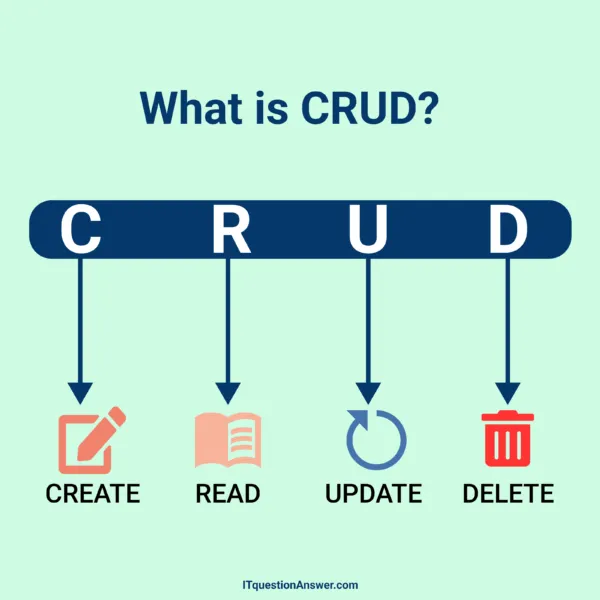
CRUD stands for:
- C – Create
- R – Read
- U – Update
- D – Delete
These four operations form the backbone of databases, APIs, CMS platforms, dashboards, and web/mobile applications.
CRUD Full Form
CRUD = Create, Read, Update, Delete
It represents the four essential actions that can be performed on any data record stored inside a database or software system. Every time data is added, viewed, edited, or removed — CRUD is involved.
Why CRUD Is Important?
CRUD is important because:
- Every application needs data operations
- It defines a clear structure for backend systems
- Makes development, testing, and debugging easier
- Improves communication between frontend and backend developers
- Forms the base of APIs, admin panels, dashboards, and CMS systems
Without CRUD operations, no application can store or manage data properly.
CRUD Operations Explained
1. CREATE
The Create operation is used to add new data into a database or system.
Examples:
- Creating a new user account
- Adding a new product to an online store
- Submitting a contact or registration form
2. READ
The Read operation is used to retrieve or view existing data.
Examples:
- Logging into your account
- Viewing product details
- Displaying user profiles or order history
3. UPDATE
The Update operation is used to modify existing data.
Examples:
- Editing profile information
- Updating product price or description
- Changing password or email address
4. DELETE
The Delete operation is used to remove data permanently or temporarily.
Examples:
- Deleting a message or comment
- Removing a post
- Deleting a record from an admin panel
Real-World Examples of CRUD
Example 1: Social Media App
- Create → Upload a new post
- Read → View someone's profile
- Update → Edit your post caption
- Delete → Remove your post
Example 2: Online Store
- Create → Add a new item to cart
- Read → View product details
- Update → Change item quantity
- Delete → Remove item from cart
Example 3: Banking App
- Create → Add a new beneficiary
- Read → Check account balance
- Update → Edit profile details
- Delete → Remove saved account
CRUD in APIs
Most modern APIs follow the CRUD structure using HTTP methods:
| CRUD Operation | HTTP Method | Meaning |
|---|---|---|
| Create | POST | Add new data |
| Read | GET | Retrieve data |
| Update | PUT / PATCH | Modify data |
| Delete | DELETE | Remove data |
This is why CRUD is considered the backbone of REST APIs.
CRUD in Databases
In SQL Databases:
- Create → INSERT
- Read → SELECT
- Update → UPDATE
- Delete → DELETE
In NoSQL Databases (MongoDB):
The same CRUD actions exist but data is handled in JSON-like documents instead of tables.
Benefits of CRUD
- Standard structure for application development
- Easy maintenance and scalability
- Faster development process
- Better data organization
- Easy to understand for beginners and professionals
FAQs – CRUD Meaning
1. What is CRUD used for?
CRUD is used to manage data in software applications, websites, databases, APIs, and admin systems.
2. Is CRUD only for databases?
No. CRUD is used in APIs, apps, CMS platforms, dashboards, and backend systems, not just databases.
3. Which programming languages use CRUD?
All programming languages like Python, PHP, JavaScript, Java, C#, Ruby, etc., use CRUD operations.
4. Why is CRUD important for beginners?
CRUD is the foundation of backend development, making it essential for beginners to understand.
5. What is the difference between CRUD and API?
An API is a communication interface, while CRUD defines the actions performed on data through that API.